

The useful delusion
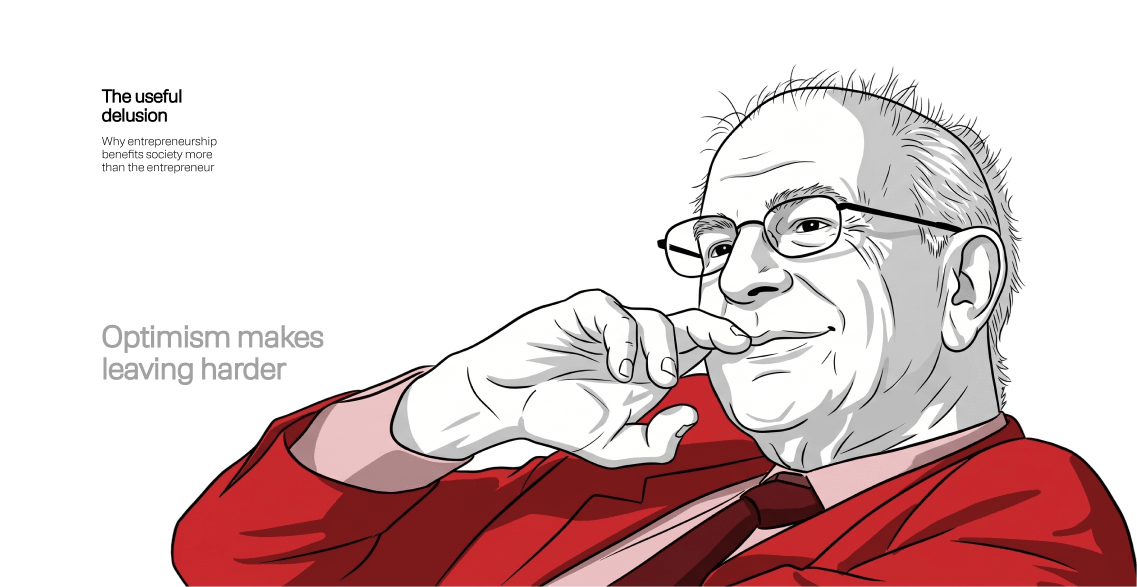
On Kahneman’s observation that entrepreneurship is better for society than it is for entrepreneurs
Damian Fozard
In July 2024 I was negotiating the sale of my business. It was the event that 30 years of building, several companies and a few failed attempts along the way had been pointing at, and for those weeks two parties were bidding for it and I was working both of them to secure the best price. What almost nobody at the table knew was that I was carrying something else. My mother had gone into palliative care, and I had tickets booked to fly home with my family to be with her. On the Thursday night the documents that began the sale were signed. On the Friday morning I woke ready to fly, and my uncle rang to tell me that during the night my mother had died peacefully in her sleep. She would never know that her son had succeeded.
I put that at the front because everything that follows is about what the thing is for, and on that Friday morning I had the clearest view of it I have ever had. The success was real. It was also, on the day it arrived, weightless against what it could not buy, and the accounting Daniel Kahneman set out, which is the subject of this essay, is easier to read from that seat than from any other.
Daniel Kahneman, in Thinking, Fast and Slow, devotes a chapter to entrepreneurship and arrives at a finding that has stuck with me longer than almost any other in the book. Most new businesses fail. The five-year survival rate Kahneman cites for American small businesses is about 35 per cent; the Bureau of Labor Statistics series I quote below puts it nearer a half, and the difference is one of period and definition rather than of substance. When American entrepreneurs were asked about the odds of their own particular ventures, however, 81 per cent put them at seven in ten or better, and a third said their chance of failing was zero. The mismatch is not subtle. It is not within the bounds of normal optimism. It is the systematic, reproducible overconfidence that has, in his analysis, become a structural input to the modern capitalist economy.
His conclusion was harder than the headline. Entrepreneurs need optimism, he argued, and entrepreneurship is better for society than it is for the people doing it. The aggregate productive effect of new ventures in any developed economy is large. The customers are better served, the competitors are sharpened, the capital is allocated to its experiments, the employees acquire skills and exposures they would not otherwise have, and the small subset of ventures that win at scale create wealth out of proportion to the inputs. The cost of the experiment is paid disproportionately by the founders themselves, the majority of whom would, on a strict financial accounting, have been better off as salaried employees of a competent firm.
I have spent 30 years inside this calculation, and the sale that July closed almost 20 years of building one company, day in and day out. The view from the exit is different from the view from inside, and this is the version of Kahneman’s argument that takes account of both.
I. The Maths
The numbers are worth being specific about, because the casual reader of business writing is steered towards the impression that founders, in aggregate, do well. They do not. The US Bureau of Labor Statistics and equivalent surveys in the United Kingdom both find that around 20% of new small businesses fail in the first year, 45% within five, and 65% within ten. The survival rates vary by sector, by capitalisation, and by whether the business required venture funding, but the order of magnitude is stable. Most new businesses do not last.
The compensation numbers are starker still. Barton Hamilton, in a study of self-employment earnings published in the Journal of Political Economy in 2000, found that the median entrepreneur earns less, across the life of the business, than they would have earned in a comparable salaried role. The mean is closer to break-even, lifted by the long tail of successes. The median, which is the experience of the typical founder, is below salary. This is true even when the venture survives. Founders are routinely the last to be paid, the first to forgo compensation when cash is tight, and the most exposed to the personal costs (mortgage, health, time, marriage) that a salaried employee is, structurally, insulated from.
The shape of the outcome distribution explains why this can be socially productive while remaining personally costly. The successful ventures, when they win, win large. A small percentage of new businesses produce the great majority of the new value in any given decade. Venture capital is built around this distribution explicitly. The portfolio works because one bet returns many multiples while most of the others return nothing. The founder, however, is not running a portfolio. The founder is running one bet, the one they happen to have made, and almost all of the founders whose bet does not happen to be the rare winner are subsidising the small number whose bet is.
II. The Subsidy
Where does the value go?
The customers receive better products at lower prices than they would have done in the absence of the founder’s bet. The competitors are forced to raise their game, which benefits their customers in turn. The investors hold an asymmetric position: they win on a few, lose modestly on the rest, and the modal investor in venture capital still does well by virtue of holding the portfolio rather than the single bet. The employees of the new venture acquire skills, network, equity exposure, and (in the success cases) a step-change in their professional trajectory. The state benefits from the tax base when the venture succeeds and from the experiment-generation when it does not. Each of these parties captures some of the value the founder’s labour produces.
The founder, on the median, captures less. This is not a complaint. It is, on inspection, a description. The founder accepted a risk that no one else in the chain was prepared to accept on equivalent terms. The founder’s willingness to take the bet is what produced the value for the other parties to capture. If founders, in aggregate, were rational about their odds, the bet would not get made, and the value would not arise. The system depends on the founder being wrong, and the wrongness is, in the structural sense, useful.
What makes the observation hard to absorb is that the same useful wrongness, on the individual level, is the source of a great deal of real personal cost. The marriages, the missed years with the children, the health one trades for capital, the friends one stops seeing because there is no time. None of this is theoretical. It is the cost of running the experiment, and the experiment is, on the median, not financially rewarded in proportion to it.
III. The View From the Exit
The view from the exit teaches something the view from inside cannot.
For nearly two decades, the company I had built was the centre of my attention and the centre of my family’s life. There was a payroll to meet on the fifteenth and the thirtieth of every month, a customer pipeline to manage, a regulator to satisfy, a board to brief, and a staff to recruit, retain, develop, occasionally let go, and (when it mattered) protect. The texture of those years is the texture of a person who has held two things in their mind continuously, the operations of the present and the trajectory of the future, and has tried to keep them both moving. The delusion that kept me in the seat was a particular one. It was that we were always close to the inflection point. Always one customer, one product, one decision away from the moment at which everything we had been building would compound. The delusion was wrong about the proximity of the moment. It was not, in the end, wrong about its existence.
From the exit, looking back, two things become visible that I could not see clearly while I was inside.
The first is that most of what I worked hardest on during those years did not, in retrospect, move the needle on the company’s value. The deals that mattered were not the ones I most expected to matter. The hires that mattered were not the ones I spent the most time on. The decisions that mattered were, in many cases, ones I made quickly and casually, and the decisions I agonised over were often the ones the system corrected on its own. That is how a complex business works. The signal is in the unexpected places, and the founder’s day-to-day attention is, almost by necessity, on the visible places.
The second is more uncomfortable. The thing the delusion was for, more than anything else, was duration. It kept me in the seat long enough for the things that were going to work to compound, and long enough for the things that were not going to work to be discarded. Almost everything I am proud of, at the company, took longer than I had projected, cost more than I had budgeted, and required more iterations than I had been prepared to commit to up front. If I had known the actual cost at the start, I might not have started. If I had known the actual cost in year three, or year seven, I might have stopped. The optimism was the load-bearing structure through the years in which the company was, on a strict accounting, losing more than it should have been.
IV. The Honest Position
The version of advice this essay is not going to give is “be more realistic.” I am not going to give it. The system needs the optimism, and the founder who replaces it with a cold-eyed expected-value calculation will not make the bet in the first place. The aggregate effect of more honesty about the odds, applied universally, would be fewer new ventures, fewer jobs, less innovation, less wealth, and less aggregate good. Whatever else one thinks of capitalism, this is the engine. The strongest objection to that sentence comes from Colin Camerer and Dan Lovallo, whose experiments on overconfidence and excess entry, published in 1999, found that people who believe their skill is above average enter competitive markets in numbers the market cannot support, and that the entrants as a group lose money; on their reading the delusion is not a subsidy to society but a tax on the deluded, and the excess entry destroys value on the way out. I take the objection seriously because it describes a good deal of what I have watched. Where I part from it is on what counts as the product. The failed entrants in their experiments produced nothing; the failed entrants in an economy produce trained people, tested ideas and competitors who have been made to move, and the winners that the excess entry makes possible would not exist at a rational rate of entry. The tax is real and the subsidy is real, and the honest position is that both are paid by the same people.
The honest position, the one I sketched in The Entrepreneur’s Burden and want to extend here, is the both/and. The founder needs the optimism to take the bet and to keep going. The founder also needs the brutal realism to know what the bet has actually delivered, and to act on that information at the points where action is still possible. This is the gate I called Delusion and Brutal Honesty. The hardest application of it is not at the start. It is at the end.
Knowing when to sell is harder than knowing when to start. The founder who started with the unreasonable confidence has spent ten or 15 or, in my case, 20 years inside that confidence, and the same faculty that made the venture possible makes the exit conceptually difficult. There is always one more decision the company is allegedly one decision away from. There is always one more customer who might be the moment of compounding. There is always a reason that this quarter is the wrong quarter to sell, this year is the wrong year, this buyer is the wrong buyer. The delusion that was useful at the start becomes, eventually, an obstacle at the end.
The version of honesty that matters at the exit is the version that admits the bet has, by then, been made. The remaining question is not whether to keep playing it. The remaining question is what the position is now actually worth, who is offering what for it, and whether the marginal year of continued effort is going to compound or not.
After the Exit
When any other founder should sell is too local a decision, too contingent on stage and family and balance sheet, for general advice to be useful. The point that remains is the structural one.
The useful delusion is the input the modern economy depends on. It is the founder’s contribution to the system. The cost of it, on the median, is paid by the founders, and the benefits accrue to almost everyone else. This is not a moral failure of capitalism, and it is not a moral triumph. It is a description of how the engine works.
For me, the exit was the moment at which the delusion stopped being useful. Until then, it had held me in place through years in which the spreadsheet, if I had been able to read it cleanly, would have told me to leave. After it, the same instinct would have kept me there too long. The decision to sell was not, in the end, a financial one. It was a recognition that the chapter the optimism was for had closed, and that the next chapter required a different instrument. The chapter closed on a Thursday night; what it had been weighed against all along became plain on the Friday morning.
Most of the founders I admire have known when to walk away. None of them have made it look easy.
More essays

The terrible job
Your first question

The evolution of complexity, entropy, and ambiguity in a perception system

What sport actually teaches

What AI reveals about human sentience, free will, and creativity

Assessing the Suitability of a Problem for AI

Entropy, ambiguity, and the evolution of the human mind

AI interviews well

The rise of AI consumerism: Living in a world of invisible algorithms

The Mathematical Principles of Information

The future of AI and the path to artificial general intelligence
