

Your first question
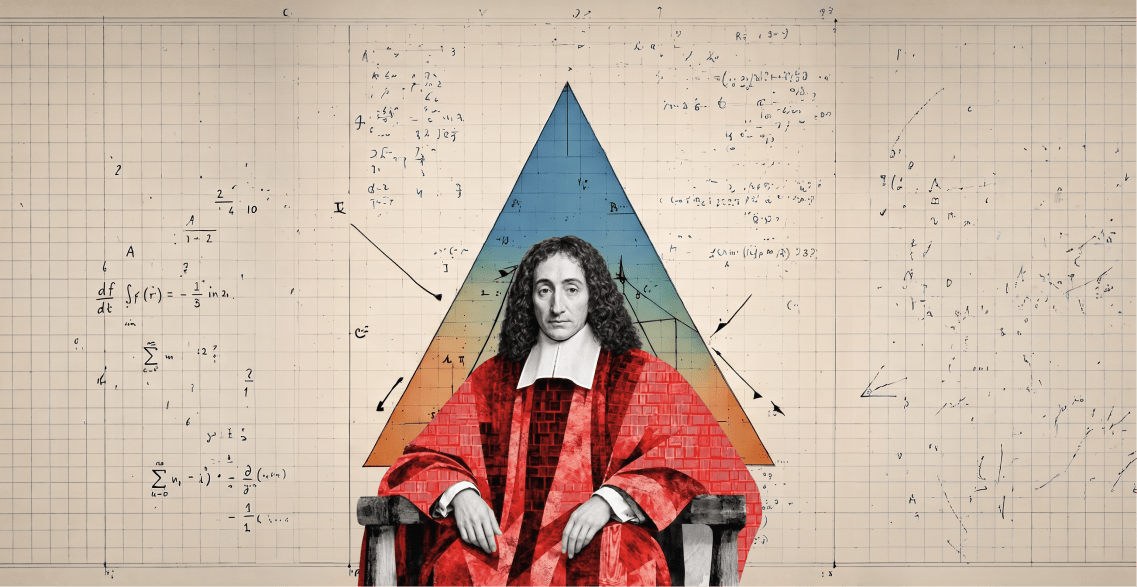
On Pascal’s wager, the one premise its author never tested, and the habit of asking what an elegant argument stands on
Damian Fozard
The Note in the Coat
In the summer of 1662, in Paris, a man died at 39. Someone going through his clothes found a piece of parchment sewn into the lining of his coat. On it, in his own hand, was a record of a single night eight years earlier, two hours of overwhelming religious experience that began with one word: fire. He had carried it against his chest, secretly, for the rest of his life, moving it from coat to coat as they wore out.
The man was Blaise Pascal, and before that night he had been the most relentless premise-checker in Europe. At 16 he wrote a treatise on geometry that startled the great mathematicians of France. At 19 he began building a mechanical calculator to spare his father, a tax official, the arithmetic of his ledgers. In 1654, in letters to Pierre de Fermat about a gambler’s dispute over dice, he helped invent the mathematics of probability: the science of pricing a bet. When the learned world insisted, on Aristotle’s authority, that nature abhors a vacuum, Pascal had his brother-in-law carry a mercury barometer up a mountain in central France, measuring as he climbed, and the falling column of mercury did what no amount of clever argument could. It checked the claim against the world, and the claim failed.
Remember both facts about him. The man who devised history’s most famous wager also helped Europe learn how to price bets and test premises. It matters, because in the bet he is famous for there is one premise he weighed once, lightly, and never tested.
The Cleverest Bet in History
Pascal never argued that God exists. His wager, found in notes published after his death, does something more original: it makes belief a matter of risk and reward and lets the arithmetic do the persuading. A rational person, it says, should live as though God exists and seek to believe in him. If God does not exist, such a person suffers only a finite loss, some pleasures and luxuries. If God does exist, the same person stands to receive infinite gains and avoid infinite losses.
The pull is easy to feel. You cannot decline to play, because living is betting: you will spend your life either as a believer or not. The stake is small, some pleasures, some Sunday mornings. The prize is infinite, and because the prize is infinite the odds barely matter; any chance at all of an eternal reward outweighs a finite cost. A bet with a tiny downside and an unlimited upside, from the man who invented the mathematics of betting. Three and a half centuries later it still corners people at dinner tables, and it deserves its reputation. It is the cleverest bet ever offered.
It is also mispriced. The problem is not the calculation but the cost Pascal entered into it, and finding that cost is the beginning of the audit.
Check the Premise
When I first read the wager I dismissed it as pointless. There is no God, so a bet on him is a bet on nothing, and the argument could be waved away in a sentence. That is what atheists mostly do with it, and it is what I did, and it was wrong. It was not wrong because the conclusion was wrong. It was wrong because the dismissal did not meet the bar I set for everyone else: there was no rigour in it and no discipline, no engagement with the man or with the premise, only a conclusion I already held used as a reason not to do the work. A believer can lean on faith. A doubter has only the argument, and I had not built one. So I went back and did the work, on the wager, on the man who made it and on the premise it stands on, and what came out was not a vindication of my first reaction but something more useful, a much fuller understanding of both the power of belief and its dangers. The rest of this essay is that work.
The habit it taught me is the one I would pass on. When an argument is elegant, do not wrestle its logic; ask what it stands on. Every argument, however brilliant, rests on premises, and the premises are where clever people leave their assumptions, usually without noticing they have done so. When an argument offers something for almost nothing, the cost is hidden in the premises. I do not fault Pascal’s logic. I fault Pascal’s premise. The premise is the stake, and Pascal did put a price on it, which I had not noticed until I read him properly: the believer, he says, will not have “those poisonous pleasures, glory and luxury”, and will acquire instead the habits of the faithful, the holy water and the masses by which belief is made to grow. He weighed the cost, and he entered it at almost nothing. A bet with a tiny stake and an infinite prize is only irresistible if the stake is in fact tiny, so the question is not whether the arithmetic is sound. It is whether belief is really that cheap, and it is not, in either direction the universe could go. I call the omitted cost the Believer’s Forfeit: the moral price of joining a system of belief, whether that system proves divinely true or entirely human. The two audits that follow price its two forms.
Two objections come before the audits, and they are not equal. The weaker one invents a friendlier God who rewards honest disbelief and punishes fake piety. It is a lovely thought and a lesson in how not to argue, because it does not check Pascal’s premise; it swaps in a different one. The stronger one is Diderot’s, a century after Pascal: an imam could reason just as well. The wager says nothing about which God to bet on, and a bet that cannot name its own prize is not a bet. I think Diderot is right, and that his objection is fatal to the wager as an argument for Christianity in particular. It is not fatal to what follows, because the audit takes the objection’s own advice and stays inside one system, the God and the scheme of salvation Pascal himself accepted. If the stake is mispriced even there, it is mispriced everywhere.
The First Audit: If He Was Right
Suppose Pascal was right. God exists, exactly as his scripture describes, and you have believed sincerely and won the bet. Heaven is yours. The prize comes with terms his calculation does not include.
In the version of Christianity the wager assumes, the promise of heaven is joined to the possibility of hell, eternal and without appeal, and the chance to escape that fate is dealt out with brutal unevenness. Sam Harris makes the point with the children of India, where hundreds of thousands of children die before their fifth birthday every year, many of them never taught Christianity, never baptised, never given the chance to place Pascal’s bet at all. On the sternest reading of the wager’s own terms they are lost, guilty of nothing more than being born to the wrong parents in the wrong country. Pascal’s Church was never quite that crude, and the Church today entrusts such children to the mercy of God. That uncertainty matters, and this audit records it. What it does not remove is the structural problem. In any system where eternal wellbeing depends on holding the right beliefs, and the opportunity to hold them is dealt out so unevenly at birth, the prize for the winners stands on ground the losers never got to choose.
To accept heaven, then, is to accept comfort with that arrangement underneath it. The reward would be inseparable from the punishment beneath it, and enjoying one while accepting the other would require a moral division of the self that I would condemn in any earthly government. If the punishment would appal me in an earthly ruler, calling the ruler divine does not settle the moral question.
Price the bet again. If God exists, the stake was never a few pleasures. It was your standing as a moral being: eternity spent giving obedience to an arrangement you would recognise, anywhere else, as tyranny. That is not a small loss. It may be the largest there is.
The Second Audit: If He Was Wrong
Now suppose Pascal was wrong. There is no God, no heaven, no hell, and the believer loses nothing eternal. The wager calls this outcome a minor loss, a few comforts forgone. The visible cost is time. The less visible cost is authority.
You have one life, and religious practice uses part of it: the observances, the rules, the questions you agree not to ask. If that were the whole cost, Pascal would be close to right. Belief is rarely a private purchase, though. Every member lends a belief system some degree of support, in money, numbers, legitimacy, and the inherited authority that lets an institution speak for millions. That authority is what makes belief systems dangerous when they go wrong. It took the accumulated belief of millions to make State Shinto strong enough to school a 17-year-old into writing his farewell letter before a suicide sortie, to make a madrassa able to send a boy in an explosive vest to a shrine festival, and to let the forced re-education of Indigenous children seem, to decent people, like the Lord’s work. None of those systems could have reached a single child without the granted authority of ordinary believers.
Membership does not make every believer equally responsible for everything done in the system’s name. A dissenter who fights abuse from inside is not morally identical to a leader who orders it. The contribution, however small, is real, and Pascal’s wager prices all of it at zero. A complete audit also has to enter the credits. Belief gives things in this life: community, music, ritual, purpose, consolation, a language for grief. Those gains are real even if the theology behind them is not, and an account that leaves them off makes Pascal’s mistake in the other direction.
That is the Believer’s Forfeit in the mortal world. Your right to believe is intact, and I will defend it against anyone, but the belief is not free. I used to finish this audit by saying that nonbelievers have everything to gain and nothing to lose. I no longer think that sentence survives its own audit. Disbelief has costs too, in conflict with family, the loss of a community, and in some places real danger. The point was never that one side bets for free. It is that Pascal counted the costs of only one side.
You may accept that arithmetic or you may find fault with it. Perhaps you think the moral share is smaller than I priced it, or that a believer can dissent from inside more cheaply than I allow. Good. That objection is you doing to me what this essay did to Pascal, and it is worth more than your agreement.
The Coat
Here is the strange, instructive thing about Blaise Pascal. He checked Aristotle with a barometer and a mountain. He checked the gamblers’ instincts with mathematics and found them wrong. He spent his life refusing to take the word of authorities, ancient or fashionable, on trust, and then he built his most famous argument on a premise he weighed once, in a phrase, and entered at almost nothing: that belief is cheap. If it could happen to him, it is not a failure of intelligence. It is a feature of minds. Most people have at least one premise they would rather not check, usually the one sewn into the lining of the coat, carried against the chest, moved carefully from year to year. My first reading of the wager was mine.
I did not take Pascal at face value, and he would not have wanted me to; face value was never his currency. I do not ask to be taken at face value either. The first time I read the wager I mispriced all of it and called that an argument. Somewhere in this essay I have mispriced something else, and I do not know where.
More essays

The terrible job

The evolution of complexity, entropy, and ambiguity in a perception system

What sport actually teaches

What AI reveals about human sentience, free will, and creativity

Assessing the Suitability of a Problem for AI

Entropy, ambiguity, and the evolution of the human mind

AI interviews well

The rise of AI consumerism: Living in a world of invisible algorithms

The Mathematical Principles of Information

The future of AI and the path to artificial general intelligence

The AI-Enabled Masters: Who Wins, Who Loses, and Who Rules
